
Keeps every service running, safely
CKN Engine runs and supervises every other service in the platform: start, health checks, deploys, rollback and logs, all driven by the state you declare rather than by hand-run commands. Releases follow a checkable procedure, and you see a problem before your customers do.
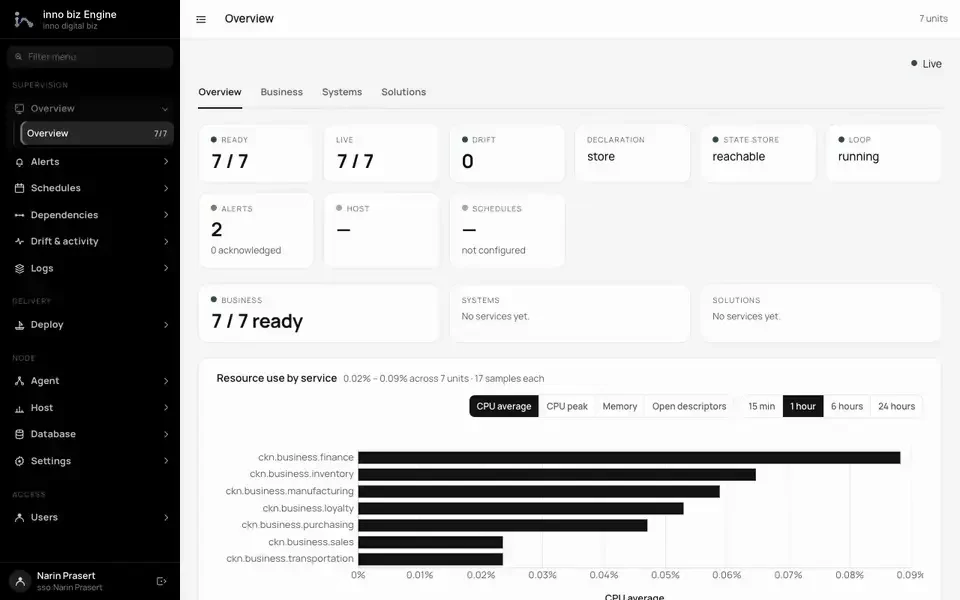
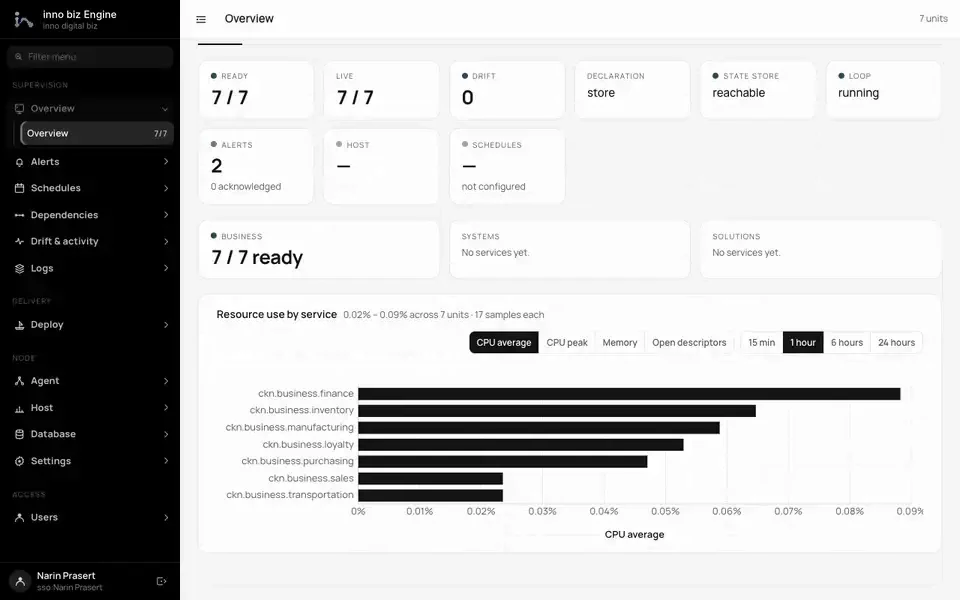
Is every service ready
How many are ready, live, drifting from what you declared, and which alerts are unacknowledged.
Who is using how much
CPU and memory per service, from the last 15 minutes to the last 24 hours.
What CKN Engine does
Declare the state you want
You state what should be running, and Engine makes it true and keeps it true, with no per-service scripts.
- Environments, nodes, applications, releases and deployments with revision history
- Discovers services from folders and declares them in one step
- Preview a plan before anything changes
- Declare dependencies between services
Keep services running
Engine keeps comparing what is running with what you declared and corrects the difference. A service counts as ready only after it passes its health check.
- A continuous reconciliation loop
- Readiness gating and dependency-ordered start
- Restart with backoff and crash-loop detection
- Services keep running if Engine restarts, and are re-adopted afterwards
Release with guardrails
Before a deploy, Engine checks what could break, and if something goes wrong you can roll back with one command.
- Rollout with drain so in-flight work finishes before a process stops
- Fleet rollout in dependency-ordered batches, plus rollback
- Contract gate compares old and new APIs and flags changes that break existing callers
- Run database migrations as part of the deploy, and hold a release that lacks a required environment variable
See what is happening
Status, logs, metrics and alerts in one place, searchable after the fact and live in Console.
- Status, replicas, the dependency graph and drift
- Captured logs, searchable by correlation id across every service, with secrets redacted
- Per-feature metrics (error rate, latency bounds), queryable up to 90 days back
- Alerts, restart incidents and live events over SSE
Control without a restart
Switch off a single feature or put a service into maintenance while it keeps running. Useful for period-end freezes or isolating a fault.
- Runtime control per Feature and module (off, drain, read-only)
- Maintenance and freeze windows
- Drain and resume a whole node
- Autoscale policy per service
Access, audit and recovery
Engine has its own operator identity, so it can start before any other service, and every command records who issued it.
- Four permission levels, optional sign-in through CKN Identity, and emergency credential use is recorded
- Idempotency-Key to prevent duplicate commands, plus audit evidence for each command
- Retention policy, plus backup export and restore of the declared state
- An MCP endpoint lets an AI agent operate Engine with the caller's own permissions
Built and tested at this scale
These figures are counted from Engine's code, documentation and test suites. They are not speed benchmarks.
Figures come from CKN's own test suites and benchmarks. Real results depend on each system's hardware and data volume.
What your business gets
Lower release risk
Engine warns which changes would break existing callers, checks required environment variables, and rolls back on demand. A release becomes a step your team can see and review, not a gamble.
Faster response, less manual work
A failed service is restarted in order, problems raise alerts, and logs are searchable by correlation id across every service. Operations does not have to log into machines one by one.
Control you can audit
Every command records who, when and the evidence. Permissions separate reading, declaring, acting and administering, and Engine keeps running even when Identity or Integration is unavailable, so it does not depend on the services it supervises.
Example: freeze part of a service without a restart
Who relies on it
- CKN Console, which is Engine's user interface
- Every business service that Engine runs, deploys and watches
- CKN Identity, for operator sign-in when SSO is turned on
- CKN Integration, which receives events and reports which processes a changed API would affect
POST https://engine.example.com/api/deployment/shop/control
Authorization: Bearer <operator-token>
Idempotency-Key: freeze-month-end
Content-Type: application/json

{"features": {"SHOP.ORDER.LIST": "drain"},
 "modules": {"reports": "read-only"},
 "reason": "month-end freeze"}

HTTP/1.1 200 OK
{"success": true, "data": {"revision": 1, "changed": true,
 "changes": [{"kind": "module", "name": "reports", "from": "normal", "to": "read-only"},
  {"kind": "feature", "name": "SHOP.ORDER.LIST", "from": "on", "to": "drain"}]}}